 deutsch

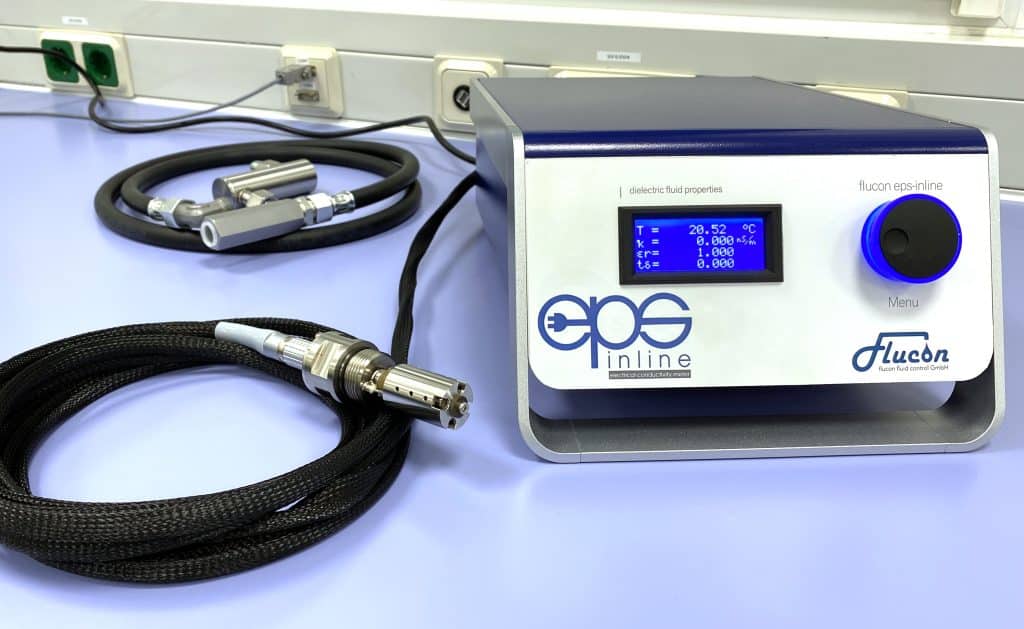
Ready for your first tests: newly developed eps-inline sensor for determining the electrical properties of flowing liquids.
Based on the EPSILON+ laboratory device, our team has developed a process-compatible dielectricity monitor for the continuous determination of the electrical resistivity and conductivity, the relative permittivity and the dissipation factor of liquids such as lubricating oils and immersion cooling fluids.
As of now and for a limited time, a few units of our latest innovation are available for testing in your application at special conditions.

The eps-inline consists of an intuitively operated electronic unit in a compact housing and a screw-in sensor based on a tubular capacitor, optimized for flow-through measurement. Using a G 3/4″ thread (and a suitable flow-through chamber if necessary), this can be easily integrated into your pipe or storage tank.
This instrument allows you to continuously determine the following parameters of your flowing media:
- specific electrical resistivity/specific electrical conductivity (20 pS/m – 500 uS/m),
- relative permittivity (“dielectric constant”) (1 – 10),
- dielectric dissipation factor as well as
- temperature.
Versatile for installation and operation.
With eps-inline, the measurement is independent of the flow shape, so that the robust stainless steel sensor offers the greatest possible installation flexibility.
The device has both a data interface (RS-232 / USB) and analog outputs (0…10 V / 4…20 mA), which can be used to transmit the measured values to your PC or PLC.
Wide range of applications.
The eps-inline can be used wherever the (di)electric properties of a flowing fluid are relevant. This includes, for example, applications in the field of server coolants, electric and hybrid drives as well as applications with lubricating and gear oils, coolants, electrolytes or other operating fluids.

Application partners wanted.
We are now looking for cooperation partners from R&D who would like to test our new system at discounted rates.
Expand the scope of your technical investigations and benefit from our expertise in the field of electrical analysis of liquids.

Want to learn more?
Are you interested in our eps-inline or would you like to check whether the device is qualified for your application?
Request further information now without obligation. We look forward to your inquiry!

Dear Flucon Team,
I hope this message finds you well.
I am currently researching the EPS-inline Fluid Dielectricity Monitor and would like to ask for more detailed technical information regarding its operating conditions.
Could you kindly provide the following specifications for the EPS-inline sensor?
Operating temperature range (minimum and maximum)
Maximum allowable pressure
Recommended or allowable flow rate range
Installation orientation restrictions, if any
Any limitations for specific fluid types or viscosities
These parameters are important for evaluating compatibility with our intended application.
Thank you very much in advance for your assistance. I look forward to your response
Hello Jawon,
Good morning from Germany and many thanks for leaving us a message.
Great questions!
The eps-inline probe is designed for use in -20°C to 180°C and will withstand 20 barg max. In case a custom design for higher pressures is required we may be able to provide that as well.
Also included with each instrument is a flow-through chamber for convenient in-line installation of the G 3/4” sensor. It comes with 10-L screwcaps and should be provided with 1-5 l/min.
We’re happy to share a scheme of the assembly as well as further technical specs in the form of a PDF brochure with you via e-mail.
Of course you’re also welcome to mount the sensor to an alternative pipe section or to a tank (where it being fully immersed is guaranteed). In this case there are really no flow rate restrictions whatsoever.
Feel free to tell us more about your application and our team will be happy to evaluate the feasibility and provide a quotation.
With best wishes,
Simon